(02) 8-898-2020
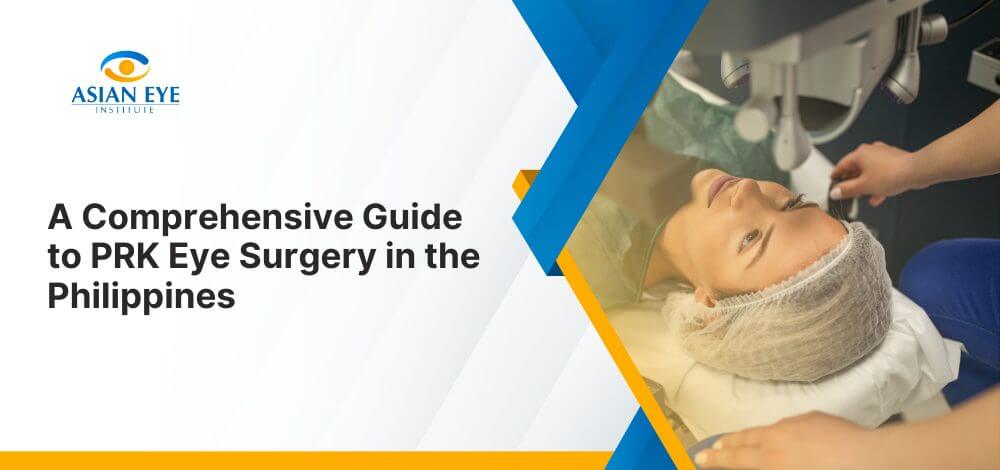
When it comes to improving vision, there have been many breakthroughs over the years that helped people see clearly again. Of course, eyeglasses and contact lenses are still some of the most common vision correction methods, and they remain popular because they are affordable, effective, and easy to use. But over the years, several remarkable improvements in eye care have emerged; surgical procedures are now available for people who want to bid farewell to their visual aids permanently.
Laser-assisted surgery is becoming a widely known practice to correct refractive errors, including astigmatism, nearsightedness (myopia), and farsightedness (hyperopia). Today, many kinds of laser-based procedures are available, and one of them is PRK, which you can get only from the most reliable eye care providers.
It is an incredibly safe and effective vision correction method, and we offer it here at Asian Eye Institute. However, if you wish to learn more about PRK laser eye surgery in the Philippines, reading this article will help. Below, we have summarized everything you need to know about this procedure, including its benefits, effectiveness, and costs.
Photorefractive keratectomy (PRK) surgery is designed to adjust the shape of the cornea to correct refractive errors. It is also a laser-based surgery that has gained widespread recognition because of how effective and safe it is in enhancing patients’ eyesight.
Here are a few things you need to know about PRK in case you plan to get it to have your refractive error corrected:
PRK is for refractive errors. However, strictly speaking, these eye conditions cannot be “treated” but can be corrected. Refractive errors usually stem from irregularities in the shape of the eyeballs, preventing light from being properly focused onto the retina.
Refractive errors are common in the Philippines, affecting people of all ages. The most affordable and arguably easiest solution is to get eyeglasses or contact lenses fitted on the patient, but if you no longer want to rely on these visual aids, undergoing PRK is one of your options.
Eye doctors and specialists recommend PRK to some of their patients because they see how beneficial it can be. Here are a few of its known advantages:
Before you undergo PRK surgery, your doctor will first determine your eligibility. Several tests will be conducted to determine whether you are suitable for the operation. During the procedure itself, this is what is likely to happen:
Sadly, not everyone is suitable to undergo PRK laser eye procedure in the Philippines. Your doctor is the one who can tell you if you are eligible, but you have a high chance if you belong to these groups of people:
PRK is advanced, but it can only correct refractive errors within a certain threshold. If your myopia, hyperopia, or astigmatism is too mild or too severe, you might no longer be eligible for PRK surgery.
For myopia, the range is between -1.0 and -10.0 diopters. The range for hyperopia is narrow; the surgery only applies between +1.0 and +6.0 diopters. Your astigmatism, meanwhile, should be below 4.0 diopters to be suitable for PRK surgery.
Your doctor will also check your overall eye health. You will only be eligible for the surgery if it is determined that your vision is stable, which means that your eyes have already fully developed and your eye grade has not change over the past year. Age is usually a determinant, so PRK is not suitable for people below 18 whose eyes are highly likely to be still developing.
Eyeglasses and contact lenses are quite effective in correcting refractive errors. But we must admit it: they can be inconvenient sometimes, especially for those with an active lifestyle. How many times have you forgotten or misplaced your glasses or contact lens case? And how many times have you accidentally broken or torn them while performing strenuous activities or engaging in a contact sport?
If you no longer want to experience such problems, PRK is an option. They can help you completely eliminate the need for glasses or contact lenses if the surgery goes well.
The cost of PRK laser eye surgery in the Philippines is affected by several factors. Indeed, the procedure can be expensive, but there are many ways to save a bit or at least avoid shelling out a large amount of cash in one go.
You can use your insurance from a private HMO, which is an effective way to cut a significant amount from the total cost of the surgery. Just be sure that you are updated on your monthly payments to avoid problems when claiming your benefits.
You can also settle your hospital bills using your credit card to eliminate the need to shave off a large sum of money from your savings. Once done, you can pay your bank via monthly or quarterly installments, which can be more economical in the long run.
PRK eye surgery can only be performed by qualified doctors. You can find them here at Asian Eye Institute. We are among the country’s most trusted eye care providers, so you can rest assured that you are in good hands if you rely on your ophthalmologists. Apart from our highly skilled doctors, we are also proud to have state-of-the-art facilities and equipment that can help improve our eye care services to patients like you.
Are you planning to schedule a consultation with us? You can do so by completing our online form and submitting it electronically. Once done, you will receive confirmation via email in just a few business days. Alternatively, you can contact us through our mobile and landline numbers so our staff can help you set up an appointment with our doctors.
PRK and LASIK (short for laser-assisted in situ keratomileusis) are laser-based procedures, but they are different. LASIK does not necessarily involve removing the epithelium to access and reshape the cornea’s surface. Instead, a small flap will be created so laser treatment can be done to change the shape of the cornea as desired.
The flap will be placed back after the procedure. LASIK is believed to have a faster patient recovery time since the epithelium will not be removed. However, the downside is that the surgery only applies to some people with thicker corneas.
After PRK surgery, patients achieve 20/20 vision, so they no longer have to wear glasses or contact lenses. However, keep in mind that many factors can affect the procedure’s overall result. Some no longer need visual aids for daily activities but still use glasses when doing close-up work and other related tasks.
After undergoing PRK surgery, your doctor will inform you how to care for your eyes while they heal. One of the things they will tell you is to never rub your eyes, no matter how itchy they get. Rubbing your eyes can slow your recovery because the cornea’s surface is still pretty delicate, especially if it has only been a few days after the operation.
However, it is normal to feel discomfort right after the procedure. When your eyes feel itchy, use the eye drops prescribed by your doctor instead.
PRK eye surgery is available to patients in the Philippines who want to correct their refractive errors permanently. It is a safe and effective procedure, and we offer it here at Asian Eye Institute.
For more information about PRK surgery or any other eye care services, contact our team. Our lines are always open, and our staff members will be more than willing to provide you with any assistance you might need.
We deliver to all our patients the highest quality eye care on a par with the best in the world. We make high-quality eye care available and accessible to the Filipinos. We advance the science and practice of ophthalmology and optometry in Asia and the Pacific Rim.
HELPFUL LINKS
CONTACT US
0917-181-2020 /
0917-191-2020
(02) 8-898-2020
Monday – Friday
8:00 A.M to 5:00 P.M