(02) 8-898-2020
Published on: February 14, 2022
You may be losing your central vision and not know it – that is how age-related macular degeneration can affect your vision. Also called AMD, it develops when the macula deteriorates. The macula is part of the retina that is responsible for central vision, which allows you to see fine details and colors.
There are two types of AMD – the dry macular degeneration and wet macular degeneration.
“The dry AMD is the common type. The macula gets thinner because of aging, and there are tiny deposits of proteins called drusen grow,” explains Dr. Patricia Quilendrino, a Retina and Vitreous Disease Specialist at Asian Eye Institute. “The wet type is less common but is more serious. Patients with this condition are likely to lose vision because of the abnormal blood vessels that grow and leak blood in the retina.”
“These yellow deposits and abnormal blood vessels cause permanent damage in the macula,” she adds. “This creates blind spots in the central vision. It will not cause total blindness, though. You may lose your central vision but not your peripheral vision.”
Reading books, telling the time, threading a needle, driving, recognizing a person and even working on your computer are just some of the things that may be difficult for patients with AMD. She says, “Because of the blind spots, they may see the clock but not see its hands; or they may see a person’s hair or ears but not the eyes, nose and mouth,” she shares.
To some patients, straight lines look wavy, colors are less bright than they used to, and some objects appear smaller than usual.
AMD does not have any signs or symptoms at first. It is also painless and develops slowly, so most people are not aware they have it. It is more common in people over 65 years old, has a family member who has AMD, and those who have hypertension. Smoking, obesity and having an unhealthy diet can also put you at higher risk of developing this eye condition.
While there are different ways to manage AMD, it has no cure yet. “Supplements, injections and laser therapies may be recommended to help preserve the patient’s vision. If the treatment options are not enough to stop or delay the progression of AMD, we can recommend the patient to undergo Low Vision Rehabilitation,” says Dr. Quilendrino.
Low Vision Rehabilitation helps minimize the effect of visual impairment by using devices like glasses with prisms and magnifying glasses. This allows patients to continue to enjoy doing the things they like.
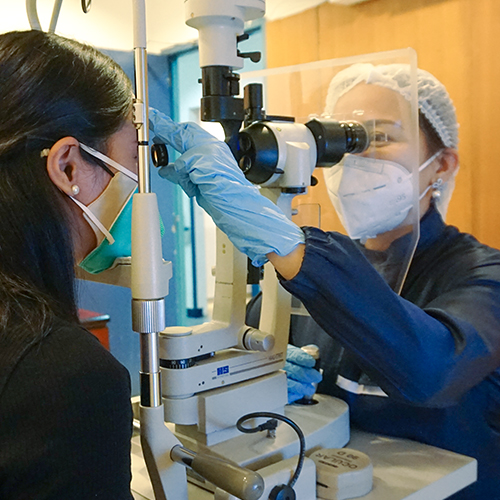
There is no way to prevent this condition, but we can prevent vision loss through annual comprehensive eye exams. She shares, “This is highly recommended, especially for people over 60 years old. Comprehensive eye exams will let us assess their eye condition and detect problems early enough to save their vision.”
“We also want to promote healthy living by quitting smoking, exercising regularly, managing their blood pressure if they have hypertension, and eating healthy.”
We deliver to all our patients the highest quality eye care on a par with the best in the world. We make high-quality eye care available and accessible to the Filipinos. We advance the science and practice of ophthalmology and optometry in Asia and the Pacific Rim.
HELPFUL LINKS
CONTACT US
0917-181-2020 /
0917-191-2020
(02) 8-898-2020
Monday – Friday
8:00 A.M to 5:00 P.M