
(02) 8-898-2020
Published on: January 31, 2022
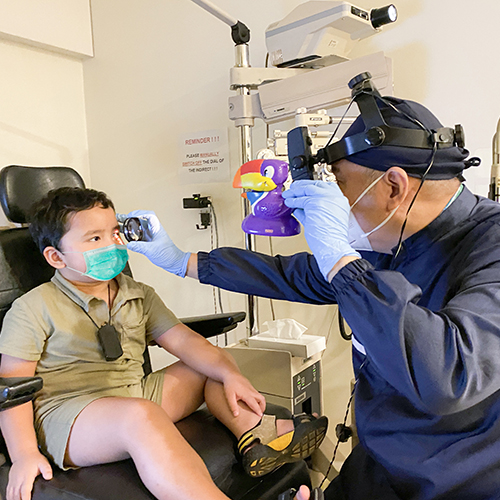
Eye problems in children often go unnoticed because children do not realize when there is something wrong with their eyesight. The thing is, uncorrected eye problems can affect how they learn, do daily tasks, or even interact with other children.
Refractive errors are the most common eye problems in children. When a child has a refractive error, it means their vision is blurry because of nearsightedness (being able to see nearby objects clearly but not those at a distance), farsightedness (being able to see far and near objects but with effort) and/or astigmatism (having distorted or blurred vision at all distances).
Asian Eye Institute Pediatric Ophthalmologist and Adult Strabismus Specialist Dr. Norman Fajardo shares that symptoms of eye problems in children vary. “Children don’t usually complain if they can’t see clearly. They think it’s normal, so we really advise parents to be observant of their children’s behaviour and to bring their children for regular comprehensive eye exams.”
“Do they consistently sit too close to the TV or hold a book too close? Do they squint or tilt their head when watching TV or looking at something? Do they complain of headaches, especially in the afternoon? These often are signs they are experiencing eye problems. Rubbing their eyes can be one too. They think that their vision can become clearer if they rub their eyes,” he adds.
Aside from refractive errors, children can also develop other eye problems, including lazy eye (the brain ignores the images from the eye, so they cannot see clearly even if they wear eyeglasses or contact lenses); strabismus (misaligned eyes, more commonly known as pagkaduling and pagkabanlag), glaucoma (abnormally high eye pressure that may lead to permanent blindness) and cataract (clouding of the normally clear lens of the eye that may also lead to blindness).
“The best way to protect your children’s vision is by having their eyes checked,” says Dr. Fajardo. “We recommend to have their vision screened at birth, and at age 3. Then they can get comprehensive eye exams before their school year begins. It is important to detect eye problems as children are more responsive to treatment when diagnosed early. It also reduces their risk of permanent visual impairment.”
Is your child showing any of these signs or symptoms? Schedule a comprehensive eye exam by calling 8-898-2020 or 0918-898-2020, email us at [email protected], or message us on our social media accounts.
—
Watch Dr. Norman Fajardo’s FB discussion where he talked about eye misalignment (strabismus), its causes and treatment options.
We deliver to all our patients the highest quality eye care on a par with the best in the world. We make high-quality eye care available and accessible to the Filipinos. We advance the science and practice of ophthalmology and optometry in Asia and the Pacific Rim.
HELPFUL LINKS
CONTACT US
0917-181-2020 /
0917-191-2020
(02) 8-898-2020
Monday – Friday
8:00 A.M to 5:00 P.M